Managing each panel separately
The Trendyol panel, the Hepsiburada panel, the site panel: the same job repeats once per channel. Stock gets updated on one channel and forgotten on another; a product that is out of stock can still be sold.

Marketplace integration is managing products, stock, prices and orders across sales channels such as Trendyol, Hepsiburada, N11 and Amazon in sync from a single management panel: stock is updated in one place and propagates to every channel, and orders arrive in a single list. This guide covers the definition, the difference from manual tracking, the Turkish market figures and how an integrated panel works day to day.
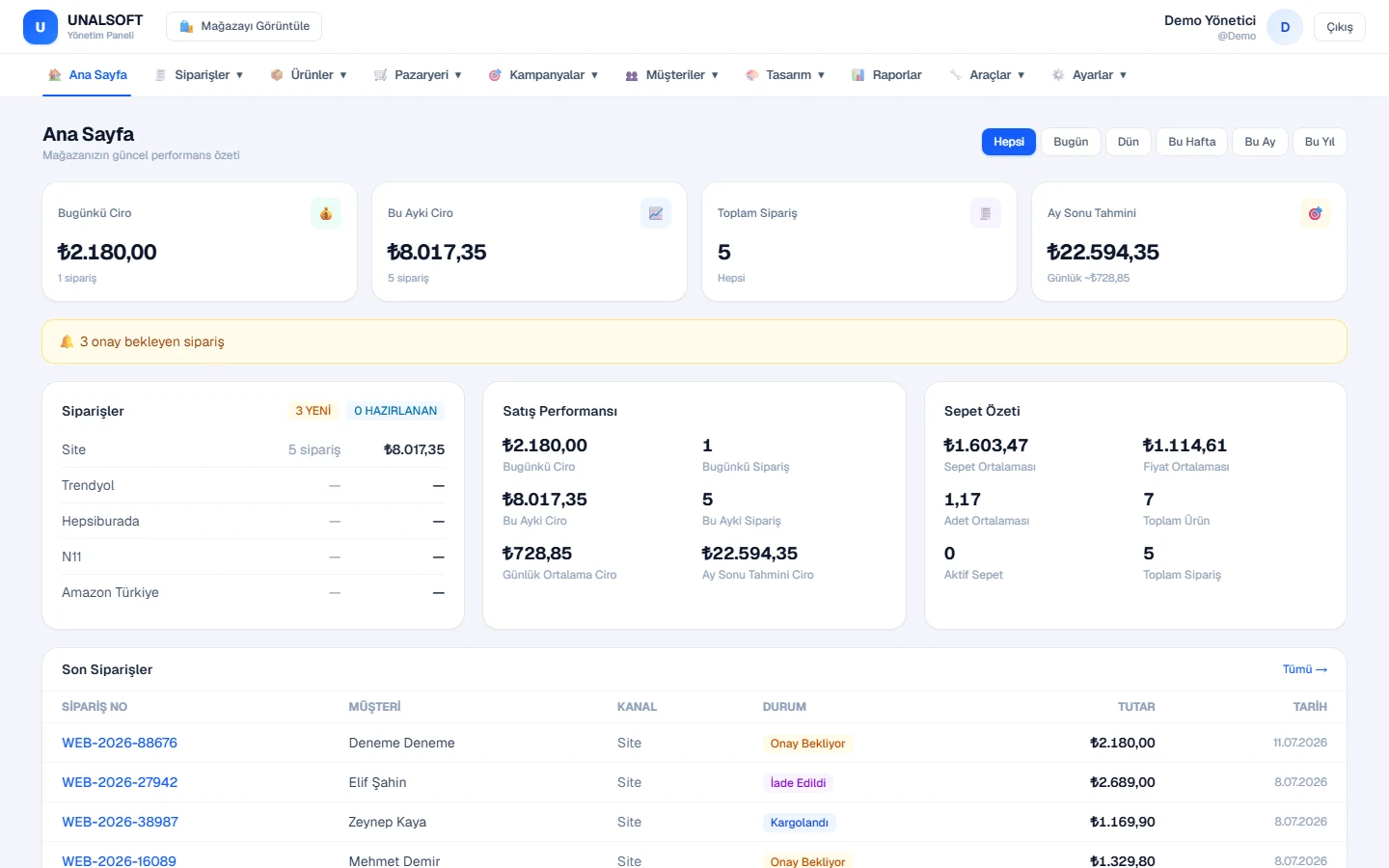
Marketplace integration is unifying an operation that runs across multiple sales channels (marketplaces plus the business's own e-commerce site) in a single software layer. Product listings, stock levels, prices and orders are kept in sync across channels: when a product sells on Trendyol, its stock is automatically reduced on Hepsiburada and on your own site; a price is updated once and applies on every channel; orders from all channels are collected, confirmed and shipped from a single list. UNALSOFT's E-Commerce Management Panel is a working implementation of this approach: your own store and your marketplace accounts run in the same panel.
There are three ways to sell on multiple channels. The distinction is simple: separate panels mean shuttling back and forth, spreadsheets are carried by hand, an integrated panel flows in sync.
The Trendyol panel, the Hepsiburada panel, the site panel: the same job repeats once per channel. Stock gets updated on one channel and forgotten on another; a product that is out of stock can still be sold.
Stock and orders live in a spreadsheet and are entered into each channel by hand. It works as long as the sheet stays current; on the first busy day, sales and the sheet drift apart.
Products, stock, prices and orders are kept in sync in a single panel. An update made in one place propagates to every connected channel; orders are managed from one list.
| Dimension | Each panel separately | Manual spreadsheet tracking | Integrated panel |
|---|---|---|---|
| Stock synchronization | Updated by hand on every channel | Kept in a sheet, entered into channels by hand | Updated in one place, propagates to channels |
| Price updates | One separate action per channel | Delays occur between the sheet and the channel | One action, valid on every channel |
| Order collection | A separate list in every panel | Orders copied into the sheet by hand | All channels in a single list |
| Error risk | Grows with the number of channels | Open to copy and delay errors | Low, because everything is in sync |
| Time cost | Daily shuttling between panels | Constant sheet maintenance | One flow in one panel |
Official data shows the scale of multi-channel selling. Every figure below is sourced:
Türkiye's e-commerce volume in 2025, up 52.2% year over year; roughly 115.5 billion in US dollars. Source: Turkish Ministry of Trade, 2026.
E-commerce's share of total trade in Türkiye (2025); its share of national income is 6.9%. The number of businesses doing e-commerce reached 634 thousand. Source: Turkish Ministry of Trade, 2026.
The number of businesses in Türkiye selling through marketplaces (2023 report); businesses registered with ETBİS to sell through their own site or app exceed 35 thousand. The center of gravity of sales is the marketplaces, which is why managing more than one channel is daily work. Source: Turkish Ministry of Trade, Outlook of E-Commerce in Türkiye Report.
The weight of the average Turkish e-commerce page; 40% of it comes from images. This independent index, measuring 27 sites across 6 sectors, shows why managing product images from one place, optimized, matters. Source: UNALSOFT, Visual Weight Index of Turkish E-Commerce, 2026.
The items below are real capabilities of the UNALSOFT E-Commerce Management Panel; they can be explored on the live demo.
A fast, mobile-friendly storefront: products, cart, payment and shipping, running under your brand's name.
Trendyol, Hepsiburada, N11, Amazon; orders and stock are managed from a single panel.
Orders from all channels in one list: confirm, ship, process returns, all in the same flow.
Update in one place and it applies on every channel; critical stock alerts arrive automatically.
Discounts, coupons and campaigns are set up in the panel, run across channels and show their impact in reports.
Sales, product and customer reports: revenue, best sellers, categories, shipping, returns in one interface.
The difference is not the integration list; it is the panel's live demo being browsable and everything sitting in one system.
The panel is not a promo image: it can be explored with its real screens at demo.unalsoft.com.
The e-commerce site, the marketplace panel and ads management come from the same team; stock, order and campaign data meet in the same flow.
Set up for the commission, shipping and returns realities of Trendyol, Hepsiburada and Amazon; not theoretical, but how the field actually works.
Marketplace integration is managing products, stock, prices and orders across sales channels such as Trendyol, Hepsiburada, N11 and Amazon in sync from a single management panel. Stock is updated in one place and propagates to every channel; orders from all channels arrive in a single list.
In the UNALSOFT E-Commerce Management Panel, marketplaces led by Trendyol, Hepsiburada, N11 and Amazon Türkiye, plus the business's own e-commerce site, are managed under one roof; orders, stock and prices flow centrally.
Yes. During setup your existing marketplace accounts (Trendyol, Hepsiburada, N11, Amazon) are connected to the panel and stock and prices synchronize. The panel also runs your own e-commerce site; products, categories and the theme are configured for your brand.
Yes. demo.unalsoft.com is a live demo store; at demo.unalsoft.com/admin you can log in to the management panel with Demo / Demo-1234 and explore the order, stock and report screens yourself.
Products, stock and prices are updated in one place in the panel and apply across every connected channel; critical stock alerts arrive automatically. The goal is to remove the burden of manually updating the same product once per channel.
The cost depends on the number of channels, product volume and setup scope. That is why, instead of a fixed list, scope and budget are clarified together in a discovery call; a needs map is drawn up over the demo.
Let's move your store, your marketplaces and your stock into one panel; let's walk through the demo together.